


Understanding Minnesota’s MCA Scores: A Guide for Families, Educators, and Communities
By Madie Spartz
Every year, the release of the Minnesota Comprehensive Assessment (MCA) scores ramps up public discussion on the state of our schools and how students are faring academically. This year, some notable changes to the test make it even more important to fully understand the MCAs: what they can tell us, what they can’t, and how families, communities, and decisionmakers should think about the results.
See below for our guide to the MCAs, including an overview of what’s changing this year.
What are the MCAs?
The Minnesota Comprehensive Assessment, or MCAs, are the statewide standardized tests aiming to measure how well Minnesota students have learned statewide standards in reading, math, and science. Students take reading and math tests in grades 3-8 and once in high school. The science MCA is taken in grades 5, 8, and once in high school.
While students take other tests, this is the only measure that lets a parent, a district, or the Legislature compare outcomes across all 500-plus Minnesota school districts and charter schools with the same measuring tool. Other tests are usually school or district specific, and not designed to answer the question of whether students are learning state standards.
Despite narratives to the contrary, almost all students in tested grades take the MCA every year. In 2025, 95% of students took the reading MCA and 93% took the math MCA. While elementary students are almost universally completing the tests, participation rates in high school are lower than the statewide average: about 85% for reading and 75% for math. Given what MCA results can tell students, families, and schools about how students are meeting standards, it’s worth exploring why older students are less inclined to take the assessment.
Why are the MCAs important?
In addition to what MCA results can tell us about proficiency at the individual, school, district, and statewide level, they are a critical tool for education equity. Without a standardized measuring tool, we can’t objectively measure or track progress toward reducing disparities in academic outcomes by race, income, ability, and language learner status—and moreover, it makes it even easier to sweep patterns of systemic failure under the rug.
Many are quick to praise Minnesota’s education outcomes relative to other states, but when you zoom in on the data, Minnesota has some of the starkest disparities in the nation. In 2025, 57% of white fourth graders read at grade level, compared with 26% of Black fourth graders and 24% of Hispanic fourth graders. Low-income fourth graders were half as likely to be proficient in reading as their more affluent peers—29% versus 59%. If we don’t have a clear understanding of the opportunity gaps in education, we will not solve them.
Conversely, MCA scores can highlight bright spots and allow education leaders to identify schools that are beating the odds or showing marked growth year over year. Their stories should be elevated as potential models for other schools to follow.
What do MCA scores tell us, and what do they leave out?
The MCAs are designed to measure whether students are meeting grade-level standards in core subject areas. State standards are revised every 10 years, and once standards change, it’s no longer accurate to compare subsequent MCA results to previous years. For example, this year’s results are the first reflecting Minnesota’s new reading standards. That means that the 2026 test measures slightly different goals than the 2025 test, and we can’t make a true apples-to-apples comparison; they are two different tests measuring different sets of skills. The 2026 MCA reading results will represent a new benchmark for the next decade.
Another important change this year is the test’s new cut scores and proficiency labels, replacing the familiar “Does Not Meet/Partially Meets/Meets/Exceeds” framework. Moving forward, that language will be “Beginner/Intermediate/Meets/Exceeds.” It’s important for caregivers and community members to understand what those labels mean. A brief summary is provided below—click here for more detailed information.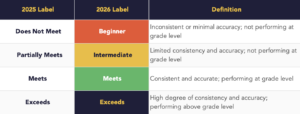 A final area of caution is the READ Act. Since the law has now been in effect for three school years, it’s tempting to use this year’s MCA scores as a gauge for whether the READ Act is working. While some early-adopter schools may be seeing movement on MCA scores, other schools are just beginning to move from professional development to implementation. Many students who took the MCA in 3rd grade in 2026 have only received evidence-based reading instruction for a few years—not their whole K-3 experience. The first cohort of students to receive the fully-implemented READ Act support starting in kindergarten won’t take the MCA until 2030.
Final Thoughts
No single metric tells the full picture of how a student, school, district, or state is doing, and all of the work happening within school buildings can’t be summarized by a single number. Still, MCA results represent a critical piece of the education puzzle and it’s important for community members to understand what they mean. As we prepare for another year of MCA data, with new proficiency labels and a new set of English language arts standards, here are more questions to move the policy conversation forward:
- Students take the MCAs in the spring, and preliminary results are available immediately. Why do parents and the public have to wait until the next school year for official results?
- Absenteeism skyrocketed during Operation Metro Surge, and recent reporting suggests 1,700 students are still missing from public schools as a result. Did Metro Surge also have an impact on MCA participation, and more importantly, on learning outcomes for specific demographics and/or regions of the state?
- What does it mean when a student brings home good grades, but their MCA scores tell a different story about their skills? (This is sometimes referred to as the honesty gap.)
- As federal education protections continue to erode, particularly around data disaggregation, how can Minnesota protect accurate and timely student data?